You know the breathing exercise. You want to practise. And then you lie there counting — and by the second round you have no idea whether that was breath 28 or 31.
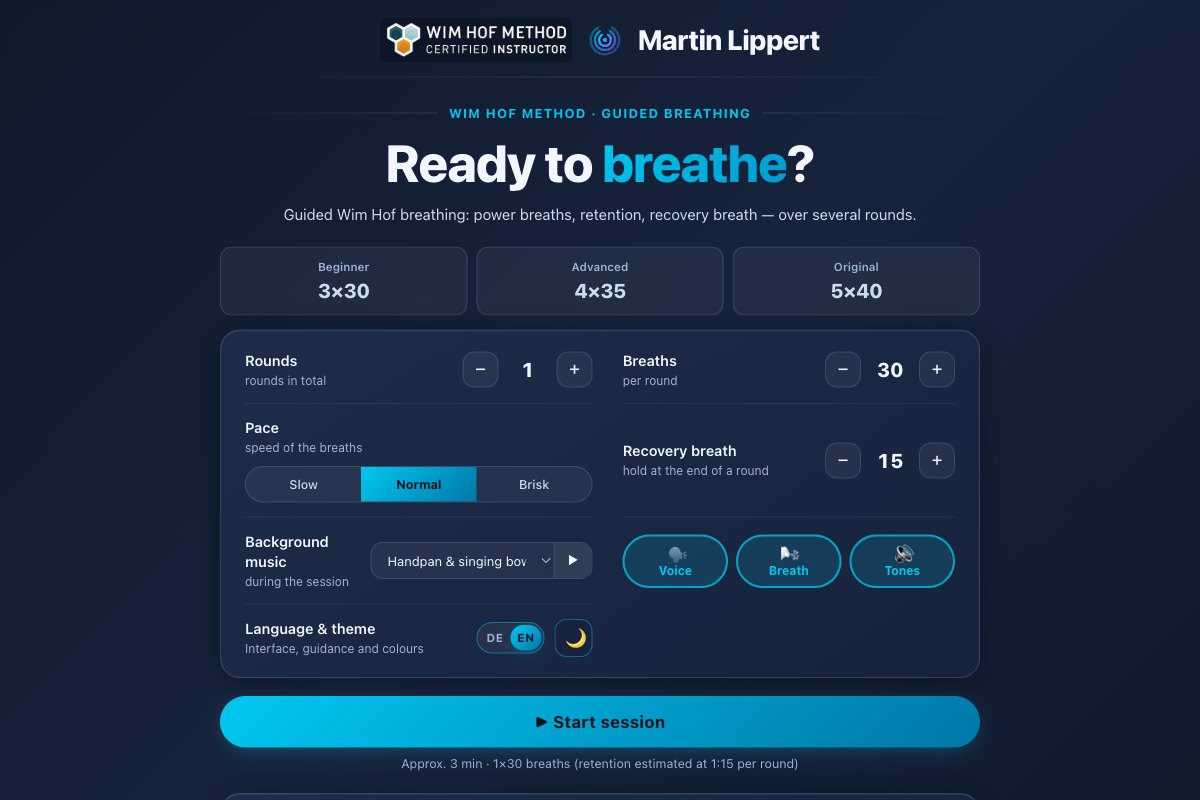
That is exactly why I built myself a timer. It counts for you. You just breathe.
Why counting pulls you out
A breathing round only works once you can let go. As long as part of you keeps counting and glancing at the clock, that part stays awake. And it is usually the very part that never clocks off anyway.
In a workshop I count for you. At home nobody does — which is why the practice quietly fades for so many after two weeks. Not out of laziness. Letting go and keeping track at the same time is simply hard work.
What the timer does for you
- It counts your breaths and lets you know when a round is over.
- It times your retention — the hold after the exhale. You never have to look at anything.
- It guides you through the rounds. Three are preset, up to nine are possible.
- It speaks English or German, one button is all it takes.
- It runs on your phone, right in the browser. Screen off works too.
No app, no account, no email address. It is free and it stays that way.
How to practise
- Lie down. On your back, on a mat or in bed. Make yourself comfortable.
- Start the timer and breathe along. Deep in, loose out. Nothing forced, nothing pushed — the timer sets the pace.
- Let the air out and hold. Don't tense up. Simply stop breathing for as long as it feels alright.
- When the urge comes, breathe in and hold briefly. The timer counts along for you.
- And then the next round. Three is a lovely place to start.
Afterwards, stay lying down for a moment. Those few minutes after the last round are, for many, the best part of the whole day.
The one thing I want you to take away
Never practise in or near water. Not in the bath, not in a lake, not in the shower.
This breathing can make you dizzy, and some people briefly pass out. On land that is harmless — you are lying down already. In water it is life-threatening. Same goes for driving, by the way.
And if you have a cardiovascular condition, are pregnant or have epilepsy: talk to your doctor first. I am not writing that because it is expected of me.
How often?
Mornings are loveliest, before breakfast, on an empty stomach. Three rounds take about twelve minutes. Stay with it for a few weeks and you will feel the difference far more clearly than after one long session.
And on a morning when you don't feel like it — then leave it. A practice you force on yourself does not last.
How your retention develops over the weeks has a lot to do with your CO2 tolerance. That article explains why holding longer does not mean you have more oxygen.
And if you want to learn it properly
A timer is no substitute for a workshop day. It helps you practise something you already know.
If you want to learn the method from the ground up — with a guided first round, the ice barrel, and someone who notices when you are pushing too hard — come to a Fundamentals workshop. We'll do it together.
Until then: the timer is here waiting for you.